your first science class 🤓
for some of you, it might be a distant memory, for some others, not at all. anyway, we are taking you back to school.


Ciao a tutt*
I am overly glad to see you back! Head-over-heels glad. You know what I mean?
In a nutshell: introductions are not over.
It is now time for Futura Care, femtech, and a first science class on hormones and the endocrine system (we're getting serious, yes).
First things first! Sharing is caring, which is why I highly recommend you to share the newsletter with at least one friend! 🥰
Summary:
Futura Care and the weather
Science class
Your to-do list (tradition)
ONE: How has your week been so far?
For those of you reading us from France, Italy, the UK, some cities in the US, how cold did it get lately? 🥶
Honestly, I was not ready to get puffer jackets out of the wardrobe. For some strange reasons, I feel like summer ended yesterday.
Anyway, back to work.
Last week, I introduced myself.
This week, I start by briefly introducing you to Futura Care.
Futura Care is the startup we founded a year ago with the desire of changing women's lives for the best.
We are a femtech startup, meaning that we put technology at the service of women's health.
Am I a doctor? Of course not! But I am a woman, and I experienced first (and second) hand the issues we aim to solve thanks to our technology.
And the issue is - roll of drums - hormones and hormonal variations. 🥁
TWO: To start on the right foot, what are hormones?
They are chemical messengers that are secreted (aka produced and discharged) in the blood. Travelling through the bloodstream, they reach tissues and organs where they complete their functions.
To make it even easier: hormones are messengers that control and coordinate different activities in our body1.
There are way more hormones than what you may think, and - buckle up - they act on way more functions and processes than the sexual and reproductive ones2.
To name a few:
They regulate body development and growth
They intervene in food metabolism
They affect mental processes such as perception, attention, memory, moods
They support the maintenance of body temperature
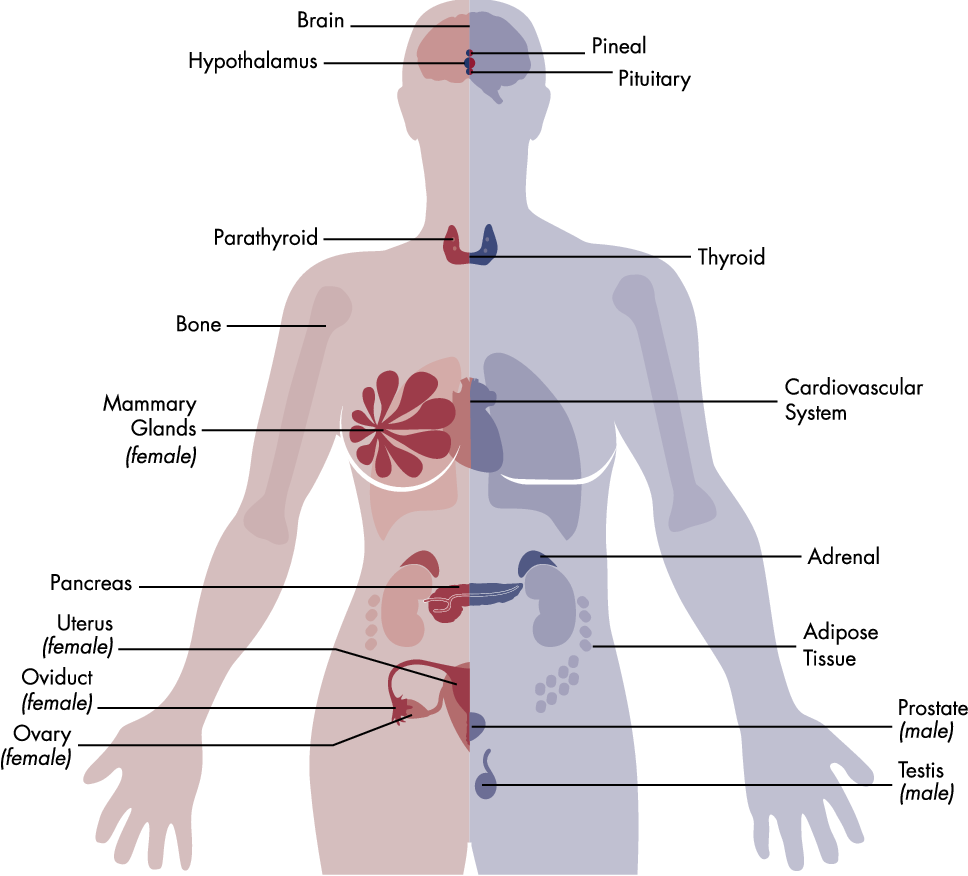
Now breathe, we are about to get more technical, which is why I am adding an image (thank me later 😎).
Who produces and releases hormones?
Endocrines glands are in charge of producing and releasing hormones into the bloodstream3.
They include the pituitary, thyroid, parathyroid, thymus, and adrenal glands.
Other glands contain endocrine tissue, which secretes hormones, such as the pancreas, the ovaries and the testes.
How are these glands regulated?
The whole of the glands producing and releasing hormones makes up for what is called the endocrine system. This physiological structure works hand-in-hand with the nervous system, in a way that the brain directs the endocrine system, and gets feedback from the glands in return.
The hypothalamus aka the switchboard: this part of the brain is in charge of controlling the endocrine system
The pituitary gland aka the master gland: tiny like a pea, powerful as a hurricane. This gland connected to the hypothalamus is in charge of regulating the activity of all the other glands
The first one sends signals to the second one that activates or deactivates the production and release of hormones.
The system auto-regulates itself to maintain the right level of hormones in the body. This process of constant adjustment is called homeostasis.
How do hormones work?
Now imagine. 💭
After a long day of dealing with calls, and meetings, and clients, and colleagues, you finally get home and you start rummaging through your bag to find your bunch of keys.
It's late-night, you are exhausted, and you cannot be bothered to turn on the light, hence you play the guessing game to get the right key-lock combination. Eventually, you find the key that actually fits the lock.

Hormones work the same. Once the signal is sent, a hormone reaches its target site, where a receptor is waiting to bind with it, exactly as a key with its lock. The hormone then clasps its receptor and transmits a message so that the target site can take a specific action.
The specificity of the hormone-receptor bond allows hormones to circulate freely throughout the body, influencing only certain organs and tissues (if anomalies are not happening).
Despite their paltry dimension, hormones are impressively forceful. Too much or too little of a specific hormone is capable of putting the equilibrium of the body at stake.
Here comes the terrifically complex world of hormonal imbalances which, however, we are going to treat another time.
Why should you be interested in staying tuned?
According to research, 8 out of 10 women4 suffer from discomfort caused by the symptoms related to hormonal variations, every day.
But, there's a but. 72% of women are not aware of the link between their symptoms and the activity of their hormones.
And we could all be part of that 72%.
THREE: We grew by 10 compared to last week. Slowly but surely!
I still think we can do better, so I count on you for the spam (healthy spam, of course).
I start receiving feedback, and I am grateful for this, but I know that there are more of you building up thoughts on this weekly appointment. What are you waiting for to share them with me? I will do my best to get back to you in a couple of working days.
Where my heroes at? You know that if you got till the end you are one! ✨
I will meet you here, next week. In case you miss us terribly, see you on Instagram (or Facebook. Twitter if everything goes down again!)
Tons of (hormonal) love,
Silvia
💖
U.S. National Library of Medicine. Hormones. medlineplus.gov. [online]. 2016
Dr. Mandal, A. What are Hormones? News Medical. [online]. 2019
Johns Hopkins Medicine. Hormones and the Endocrine System. hopkinsmedicine.org. [online]. no date
Osborne, C. Everything You Should Know About Hormonal Imbalance. HealthLine. [online]. 2020